Our first day in the house, David proudly showed me our vintage 1910 doorbell. He pushed the front door button… and nothing happened. Apparently, it had worked for him earlier. He gave up on the doorbell and wanted to show the solid construction of the house by hitting the wall. The doorbell immediately began to ring…and ring…and ring. David was fiddling around trying to turn it off, when Caylie broke in: “Uh…is it supposed to be sparking?” The wires leading to the doorbell had began to smoke. You can probably imagine the chaos of a constantly ringing, LOUD bell, and Caylie clamoring about the smoke rising from the doorbell. The only solution David had was to cut the electric wire going to the doorbell. That stopped the noise and the smoke. Obviously, the doorbell no longer worked.
We often compare our situation with “The Money Pit.” Check it out.
For a year, I had to tell people to “knock loudly.” That meant missing a lot of people at the door because I had a hard time distinguishing knocking from construction noise. Adding to the confusion are the multiple entry doors. I have actually gone from door to door and back again trying to see where the visitor is.

I was optimistic about our ability to repair the bell and included it in our kitchen electrical plans. Although the kitchen was mostly finished by the end of February, we have had four wires hanging out of the wall, and leading down to the basement, ever since. It turns out it is much more complicated to fix than we knew.
The electric doorbell was invented in 1831, but it wasn’t until the early 1900s that they used transformers with the household current. Around this time, signaling devices that produced sound by electronically oscillating a thin piece of metal became popular. The oscillator devices became known as buzzers.
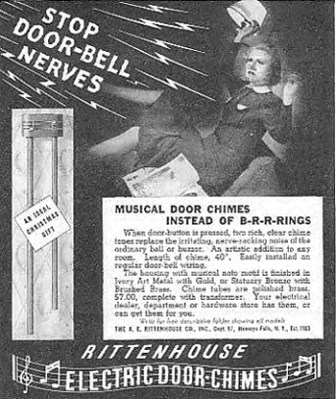 Apparently, these buzzers were a source of “door-bell nerves” as you can see in the 1937 Rittenhouse ad. In the 1930s, companies like Rittenhouse and NuTone introduced musical chimes as a more “civilized” device. A Mell-O-Tone brochure summarized the doorbell problem this way:
“How often has the peace and quiet of your home been disturbed by shrill, nerve-racking ringing of a door bell? …This new and practical door chime replaces the harsh door bell ring with a pleasant musical chime… a sound that will not annoy or startle, yet loud and persistent enough to attract attention.”
In spite of the noise, I was on a mission to repair my “brrring” doorbell and I was willing to pay for it. I just couldn’t find anyone willing to do it. This included electricians, and antique dealers. That left my husband. After a lot of cajoling, he took on the project.
The Process
Finding information on how the clapper doorbells work was not easy. David needed to know what current was appropriate: AC or DC? And what voltage was appropriate. He purchased a cheap variable DC power source, but the best he could get was a single “bing” when the wires were connected.
Finally, David found an electrical chatroom post, dated from 2010, that had a picture of a current bell that was like ours. He looked up the company, and purchased a new bell unit. When hooked up to the voltage, it also gave a single “bing”, which wasn’t the result we were looking for. But later, in the same post chain, the purchaser complained about the single clap, and another poster told him to connect one wire to one of the two screws underneath and the other, instead of to the other screw, to the body of the bell. Sure enough, the bell started ringing like crazy. David tried the same approach with our old bell, and it sprang to noisy life!


You can see from the workings that there are four places for four doorbell wires to be connected, along with a common ground. When the electrical circuit is completed by pushing a doorbell switch, current flows through the appropriate bottom coil, activating a magnet which allows a number (1-4) to drop, while simultaneously allowing the doorbell to ring. You can see the mechanism work in this video:

For the permanent installation, David had to get a power source that was between 4-5 Volts DC. Oddly enough, an internet page specified that a good option was a tattooing power supply! So, here is the actual power installation, hooked up in our basement, connecting the existing doorbell wires and the wires up to the doorbell mechanism itself.
The Result
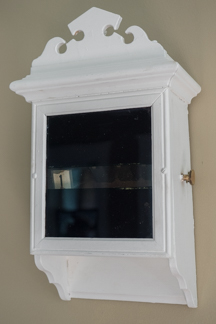
Luckily, the cabinet to house the doorbell was left for us. It was broken, but with a little glue and paint it looks great! The number falls just to the opening, so that we know which doorbell was pushed.
Now that everything works, come on over and ring the bell! We can hear you from two doors, and when we have the time, we will hook up the other two!
 Our Cranbury House
Incredible! Looking forward some day to pushing one of those bells. Now to the porch!
LikeLiked by 1 person